Monday, February 15, 2010

Find That Bird in a Sn-App


We don't claim to be birders, not by any stretch, but I can understand why people do it. Our experience with the bald eagle count was a good one, and it's tempting to think I could educate myself enough to embrace it as a hobby.

What's even more tempting is the idea that I could educate myself in the quickest, most passive way possible: through an iPod Touch or iPhone. Yep, there's an Audubon birder app that makes it easy to find birds by color, by region, or other characteristics. The best part is that the app includes bird songs so you can confirm what you  might be seeing by what you're hearing.

If birds are not enough, there are also Audubon guides for wildflowers, mammals and trees. And the apps can utilize the iPhone's GPS system to track where you've seen things.

The price per app is $10 for trees, wildflowers and malls; $20 for birds. All, including a free sampler app,  are available for download from iTunes.

Photo: Audubonguides.com

Sunday, February 14, 2010

Bald Eagle Count at Silverwood

We went to Silverwood Lake yesterday to take part in a bald eagle count. The man-made lake, a California state park located east of the Cajon Pass, is part of the wintering grounds for bald eagles that migrate from Canada.

Neither one of us had ever participated in a bird count before, but it seemed like a worthwhile thing to do while spending a beautiful day in the mountains. After what has seemed like a lot of cold and rain this winter, the promise of sunny, 80 degree weather was too good to stay indoors..

We arrived at the lake around 8 a.m., met the other volunteers near the lake marina, and split up into small groups. Each group had a birder as a leader, and a designated spot to observe for birds. One spot was the nearby dam; another was Miller Canyon, and ours was Black Oak Canyon.

The bird count at Silverwood was one of several conducted simultaneously around the state. Each one started and ended at the same time to preclude double counting a bird that might fly from one watched site to another during the course of a day. The count was set from 9 a.m. to 10 a.m.

We arrived at Black Oak just before nine, and spotted one bald eagle immediately, sitting at the top of a tall, dead tree. He perched and waited, and eventually flew a short distance to another tree. He was far from us, but still clearly visible, given his impressive size. He was counted as an adult, and unfortunately, he was the only eagle we saw. We did see some large blue herons, and the brilliant if common blue jay.

At the end of the count, we heard there were two other eagles spotted for a total of three. We headed off to a peaceful picnic near the empty lakeshore, and soaked up the sun. There will be another eagle count in March, with the opportunity to cruise around the lake on a barge. We’re up for that.

Tuesday, October 14, 2008

Pupfish Population Increasing


Photo by Stephen Osmon, Los Angeles Times


We wrote about the incredibly rare Death Valley pupfish last year, after we saw them in their tiny Devils Hole habitat in Nevada. Now the New York Times and the Los Angeles Times report that the fall count of the pupfish shows an increase in population. The pupfish, an isolated species whose numbers were down as low as 38 in 2006, now number 126. They numbered close to 500 as recently as the mid-1990s.

The counts are done in spring and fall; spring counts are typically much smaller than fall because the pupfish have a greater die off in the winter months. They are counted in the shallow rock shelf where the majority of them feed and spawn, and by divers who reach the 100 foot depths where others may swim. They are counted twice a day, and the numbers averaged for a total population figure

Biologists are not sure why the species has dwindled so precipitously since then, but suspect that a lack of nutrients is to blame. To remedy the situation, they took the highly unusual step of developing a specialized, high-nutrient fish food similar to food used to feed minnow at a New Mexico hatchery.

"It was not done lightly," Bob Williams, Nevada field supervisor for the U.S. Fish and Wildlife Service, told the L.A. Times. "When you start to artificially augment a wild population, it is a sign the species is really in trouble."

Click here for more information on the Amargosa Valley pupfish station or the pupfish home page at http://www.fws.gov/Nevada/protected_species/fish/species/dhp/dhp.html.

Sunday, September 21, 2008

Imperial Beach

Located very close to the California-Mexican border, Imperial Beach is the southwestern-most city in the United States, a small, unpretentious beach town not nearly as affluent or well-known as Coronado. Which is probably how they like it.


Located close to the beach is the Tijuana Estuary Visitor Center, where there are miles of trails and abundant bird-watching.

We had the reserve to ourselves, except for a birder who had already spent the entire morning waiting to see something. He became very excited by the appearance of a rare bird, which he pointed out to us (seen below). We have to admit, rather sheepishly, that we are not birders and therefore don't know how momentous viewing this bird was. We also can't say what it was (although it may have been a bar-tailed godwit). If anyone can positively identify this bird, please let us know.


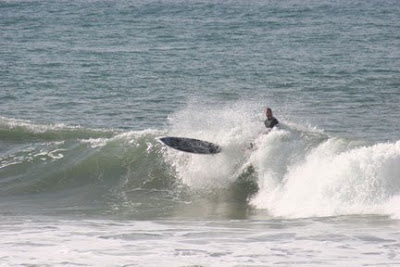
Walking across to the uncrowded beach, we came across one of those scenes that defines the archetype of Southern California--surfers. One had brought his black Lab, who was ecstatic to get out in the water, rush back to shore, and repeat the process. He may have had a better time than his master, who wiped out.


Wednesday, September 3, 2008

Card of the Week: Ashford Mill, Death Valley


It might sound odd, but Death Valley is one of the most beautiful places on Earth, and one of our favorite spots to visit. Despite its funereal name, there is plenty of life in this extreme environment. Even a little bit of rain can spur a bloom. Here is an abandoned mine now full of the wildflower desert gold.

This is one of our most popular cards. It is available for $2 each, with free shipping. A pack of 10 costs $16. To order, please contact us at info@mozaicstudio.com.