
The Los Angeles Times is reporting that the restoration of Mono Lake has led to a burgeoning recovery of lake wildlife.
Mono Lake, located in Central California near Bishop, was drained and nearly destroyed when the water from tributary streams was diverted to Los Angeles by the city's Department of Water and Power. The lack of fresh water left the lake with deadly salinity levels and created salt flat dust storms. The Save Mono Lake conservation group sued the DWP in 1978, and California courts ordered Los Angeles to reduce its water diversion.
While the lake is still below a normal level, and the Save Mono Lake group still believes it has "a long way to go," the tributaries have fostered newly lush grasses and other riparian vegetation. Trout, warblers and other birds have returned to Mono, and it seems to be on its way back to life.
Friday, July 25, 2008


Newport Back Bay

Rich and flashy Newport Beach might seem an unlikely place for a wildlife refuge, but it is, in fact, a critical estuary habitat for migratory birds. An estuary is where fresh and salt water mix, as in a creek meeting the sea. It is one of the few remaining estuaries in Southern California.

The Upper Bay, or "Back Bay," located on Back Bay Drive just off of the Pacific Coast Highway at Jamboree, is a 752-acre ecological preserve surrounded by bluffs. The California gnatcatcher, the cactus wren, the brown pelican, and the California least tern are among the rare or endangered birds that feed from or inhabit the bay. During the winter migration, as many as 30,000 birds use the bay as a stopover, making it a major bird-watching spot for minimal effort. The bay also has the Peter & Mary Muth Interpretive Center, and Back Bay Science Center.
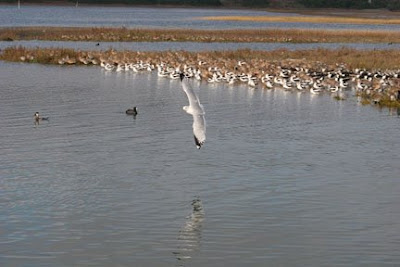
The Back Bay is easy to reach by car or bike, and has a (one way) road that will take you from end to the other. It is a popular place year-round for walkers, joggers, painters, bike riders, bird watchers, nature lovers, and photographers. For more information, check out http://www.newportbay.org.

Thursday, May 15, 2008
Desert Tortoise Relocation Plan Failing
A $8.7 million plan by the U.S. Army to relocate endangered California desert tortoises from Ft. Irwin has failed to adequately protect them, according to an environmental group.
The Center for Biodiversity in Tucson is suing the Army, the U.S. Fish and Wildlife Service and the Bureau of Land Management for allegedly violating the federal Endangered Species Act in the relocation effort.
Coyotes have killed an estimated 14 relocated tortoises, which are monitored and tracked by radio transmitters. Drought is believed to have reduced the number of rabbits that coyotes normally prey on, driving them increasingly to attack tortoises whose shells cannot completely protect them. Additionally, an infectious disease spread at a relocation training center is being blamed for the deaths of 15 baby tortoises.
The relocation was in response to the expansion of Ft. Irwin, which included the development of prime desert tortoise habitat. To protect the endangered species, the Army captured and airlifted about 760 tortoises from Ft. Irwin to public lands in the Mojave Desert near Barstow, California.
Environmental groups had warned the Army that relocating the tortoise exposed them to a number of threats, including drought-stricken foraging grounds, respitory disease, and attacks by coyotes, dogs, and ravens. For its part, the Army believed that leaving the tortoises at Fort Irwin exposed them to worse vehicular dangers, and has plans to trap and kill what it calls “a rogue band of coyotes.”
The Army has plans to relocate an additional 1200 tortoises.
Thursday, May 8, 2008
Tejon Development and Conservation

The Los Angeles Times is reporting today that a deal has been reached between developers and environmental groups that will allow the building of 26,000 new homes on pristine land owned by the Tejon Ranch Co. in exchange for the conservation of 178,000 remaining acres. It will also allow the public purchase of an additional 49,000 acres for a public park.
The Tejon Ranch is 270,000 acres of land 60 miles north of Los Angeles that is spread over Los Angeles and Kern counties, and which covers four distinct ecosystems: Mojave Desert grasslands, San Joaquin Valley oak woodlands, Tehachapi pine forests and coastal mountain ranges. It is also the habitat for the highly endangered and federally protected California condor. Part of the agreement called for the new homes to be built away from the ridgelines where the condors forage. Developers had previously sought a waiver from the government to be relieved of legal responsibility if land development resulted in a condor's death.
Other wildlife inhabiting the ranch land include bobcats, deer, coyotes, golden eagles, elk and wild turkey. A spokesman for the Sierra Club has declared it "the ecological equivalent of the Louisiana Purchase" for Southern California.
The houses will be built in the southern portion of the ranch, while an industrial complex has already gotten underway in the western-most corner, just south of where Interstate 5 forks off to the beginning of Highway 99. In addition to the objections from environmental groups concerned about wildlife, other complaints about the development were that Southern California sprawl was creeping into Central California.
Given the seemingly inexhaustible demand for new houses in Southern California, it was inevitable that one of the last great pieces of undeveloped land in the state would be carved up for housing. This may be the best deal possible to avoid losing all the land to cities and shopping malls. But with the housing bubble burst, and gas only getting more prohibitive in cost, who is going to commute 60 miles one way to L.A?
Tuesday, April 15, 2008

Subscribe to:
Posts (Atom)


 Posts

